


Mono-Cyclic Alkanes
The bonding of carbon atoms is not limited to simple chains. Carbon atoms can form cyclic structures as well. The general formula for a linear or branched chain is CnH2n+2 where n is the number of carbon atoms. In a mono cyclic ring the general formula is CnH2n . The loss of the two hydrogen atoms represents the additional carbon-carbon bond in the ring.The loss of two hydrogens from the formula CnH2n+2. Is sometimes referred to a 1 degree of unsaturation. it could mean a double bond or a ring closure.
- Naming cyclic rings follows the same rules as for linear chains, with the addition of the prefix cyclo to the name of the compound.
Names of the simple cyclic hydrocarbons
|
|
|
|
Physical Data |
|
|
|
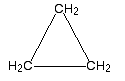 |
Tm= +55.2o
Tb = 240.35o DHf = +52.3kJ/mol DHc = --1966.0 kJ/mol |
|
|
|
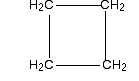 |
Tm= 182.42o
Tb = 285.66o DHf = -7.1kJ/mol DHc = ? kJ/mol |
|
|
|
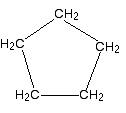 |
Tm= 179.27o
Tb = 322.41o DHf = -105.9kJ/mol DHc = -3290.9 kJ/mol |
|
|
|
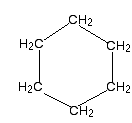 |
Tm= 1279.70o
Tb = 353.89o DHf = -156.2kJ/mol DHc = -3919.8 kJ/mol |
All of the above carbons are tetrahedral. that is they ought to have a bond angle of 109.5o However cyclo propane must have carbon carbon bond angles of 60o . This means the molecule is strained, strained molecules react more readily this is reflected in the energies shown.
Other than cyclopropane (which must be planar), cycloalkanes are also "puckered" to relieve some of the ring strain. If cyclobutane where plainar it would have a bond angle of 90ocyclopentane would be 108o.
Substitution on the ring is also possible. When the ring is larger than the longest continuous chain of carbon atoms in a substituent, the ring will be the parent compound.
Example 1.)
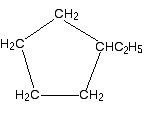
The ring is larger than the ethyl group so the name
is: ethylcyclopentane
NOTE: no number is needed as there is only a single substituent.
Multiple substituents are located on the ring by numbering clockwise or counter-clockwise from one substituent to the other(s), thus there will always be a substituent at carbon number 1. The substituent, and direction of numbering, are chosen to give the lowest total for all substituents, i.e. starting at one substituent what is the shortest distance arround the ring, in either direction, to the next substituent.. If the numbers for the substituents will be the same in either direction, then the substituent that comes first alphabetically should have the lower number.
Example 2.)
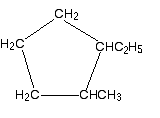
The ring is larger than both groups so the name
is: 1-ethyl-2-methylcyclobutane
NOTE: the ethyl group is first alphabetically so it gets the lower
number.
© LEV