


Personal Responsibility
The professional worker is responsible for his or her own abilities and actions. He or she has a personal responsibility to have up to date knowledge and skills so that the client is not disadvantaged by an incompetent or out of date implementation. A professional should also recognise then a particular task is beyond their competence and should be prepared to advise a client accordingly. They must be able to give impartial and objective advice and avoid any situation that causes a conflict of interest between them and the client. The professional will also take full responsibility for their work should things go wrong.
- While working for a particular client you are offered a large contract by one of his main competitors.
- A system your company has implemented for a client fails. The client believes that the failure was due to hardware but you know that it was actually due to the way the system was set up by one of your colleagues. The client has lost business and goodwill as a result of the failure.
Professional Development
The rapid development of the IT industry has led to a rather unstructured approach to training and professional development. A significant proportion of IT workers have developed their skills in response to immediate needs in the work place and have had little or no formal training. This unstructured approach leads to problems when people seek promotion or when they apply for a job with another employer.
In 1986 the British Computer Society introduced an Industry Structure Model (ISM) to provide a structure for the training and career development of professionals within the IT industry.
The ISM is a matrix. Each column represents an area of work such as Systems Development or Education and Training. Each of these areas is called a stream. The rows of the matrix are ten levels numbered from 0 to 9. An individual cell in the matrix therefore represents a particular level of one particular IT job. The cell contains a code that links to a cell definition. The cell definition gives a full description of the requirements of the job at that particular level. This description includes:
- Recommended Academic Background
- Previous Experience and skill level required
- A description of the tasks to be undertaken and the attributes required.
- The training and development that will be required by those employed for this work at this level.
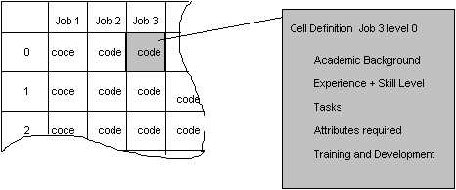
The structure is accepted nationally and is rapidly becoming international. This means that both the employer and the professional working in the IT industry have a clear idea of the skills and abilities needed for a particular job at a given level. There is also a clearly defined progression from level to level thus providing a structure for professional development.
The ISM is used in conjunction with the British Computer Society's Professional Development Scheme (PDS) to provide a nationally recognised and accredited scheme of career development that can be tailored meet the needs of both the individual and the organisation that employs them.
© LEV
