


Super Computers
These are the largest and most powerful computers made to date. They are complex very expensive and thus very rare. They are used for Weather forcasting, Space exploration, Advanced scientif research, weapons research, and drug testing. They cost hundreds of millions of pounds, and like their mainframe predecessors require a specialised working enviroment that is dust free with the temperature and humidity controlled. When they are working they generate so much heat that they are often housed in thier own special building which has false floors and cielings to carry the miles of cables they require. Often they have thier own electricity generator to ensure that they can continue to work in the event of a power failure.
According to wikipedia Current fastest supercomputer system
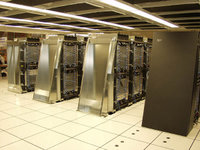 The IBM Blue Gene/L is the fastest supercomputer in the world.
On March 25 2005 IBM's Blue Gene/L prototype became the fastest supercomputer in a single installation using its 32,768 processors to run at 280.6 TFLOPS (1012 FLOPS). The Blue Gene/L prototype is a customized version of IBM's PowerPC architecture. The prototype was developed at IBM's Rochester, Minnesota facility, but production versions were rolled out to various sites, including Lawrence Livermore National Laboratory (LLNL). On October 28, 2005 the machine reached 280.6 TFLOPS, but the LLNL system is expected to achieve at least 360 TFLOPS, and a future update will take it to 0.5 PFLOPS. Before this, a Blue Gene/L fitted with 131,072 processors managed seven hours of sustained calculating at a 101.5 teraflops—another first. [1] In November of 2005 IBM Blue Gene/L became the number 1 on TOP500's most powerful supercomputer list.[2]
The Google server farm constitutes one of the most powerful supercomputers in the world.
© LEV
