


Laser Printers
Laser printers set up the image of the complete page before printing. This means that there is an initial delay while the page is processed but once printing starts the page is completed within a second or so. For this reason we call laser printers page printers.
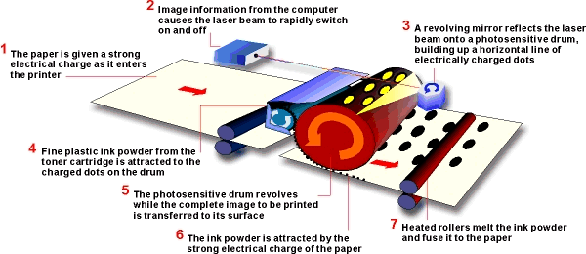
The image is formed by small particles of toner that are distributed electrostatically on the paper. The laser is used to build up a pattern of charge on a roller that then transfers the toner to the paper. The toner is then heated so that it melts onto the paper forming a permanent image.
The resolution of a typical laser printer is 600 dots per inch. This refers to the number of dots per inch used when the laser beam marks out the pattern of electric charge that is used to distribute the toner. If the toner particle size is too large then the effective resolution is reduced but a laser printer still produces the highest quality output of all the printers described. Special fine tone toner is used to obtain the best results in laser printers.
The initial cost of buying a laser printer is two to three times that of an ink jet. The running costs are however much less. In addition laser printers can print overhead transparencies and they have a higher print speed compared to an ink jet.
Laser printers are non-impact and all of them use cut sheet paper. Because of the way that they produce the image it would be very expensive to produce a laser printer handling large size paper. Most will take A4 paper and it is possible to buy an A3 laser printer. Colour is also an expensive option.
Laser printers are used when high quality output is required and there is sufficient output to justify the initial outlay or where speed of printing is important. The quality is sufficiently good for CAD applications but these often require output to sheets larger than the A4 that the normal laser printer can handle.
© LEV
