


The structure of phenol
The simplest way to draw the structure of phenol is:

There is an interaction between the delocalised electrons in the benzene ring and one of the lone pairs on the oxygen atom. This has an important effect on both the properties of the ring and of the -OH group.
One of the lone pairs on the oxygen overlaps with the delocalised ring electron system . . .
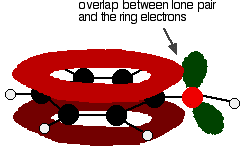
. . . giving a structure rather like this:
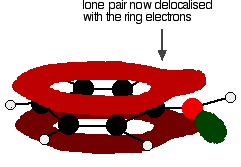
The donation of the oxygen's lone pair into the ring system increases the electron density around the ring. That makes the ring much more reactive than it is in benzene itself. That is explored in another page in this phenol section.
It also helps to make the -OH group's hydrogen a lot more acidic than it is in alcohols. That will also be explored elsewhere in this section.
Physical properties
Pure phenol is a white crystalline solid, smelling of disinfectant. It has to be handled with great care because it causes immediate white blistering to the skin. The crystals are often rather wet and discoloured.
Melting and boiling points
Exam questions sometimes compare phenol's melting and boiling points with those of methylbenzene (toluene). Both molecules contain the same number of electrons and are a very similar shape. That means that the intermolecular attractions due to van der Waals dispersion forces are going to be very similar.
| melting point (°C) | boiling point (°C) | |
|---|---|---|
| C6H5OH | 40 - 43 | 182 |
| C6H5CH3 | -95.0 | 111 |
The reason for the higher values for phenol is in part due to permanent dipole-dipole attractions due to the electronegativity of the oxygen - but is mainly due to hydrogen bonding.
Hydrogen bonds can form between a lone pair on an oxygen
on one
molecule and the hydrogen on the -OH group of one of its neighbours.
Solubility in water
Phenol is moderately soluble in water - about 8 g of phenol will
dissolve in 100 g of water.
If you try to dissolve more than this, you get two layers of liquid.
The top layer is a solution of phenol in water, and the bottom one a
solution of water in phenol.
Phenol is somewhat soluble in water because of its ability to form
hydrogen bonds with the water.
© LEV