


PHENOL
When a functional group is added to the benzene ring There are two effects.
1. the lone pairs or double bonds can effect the delocalised pi electrons. In which case it can be either electron donating like phenol where p electrons are pushed toward the arene or electron withdrawing like -C=O where p electrons are drawn away from the arene.
2. the sigma bond can become polarised ffects are those that occur through the s system due to electronegativity type effects. These too can be either electron donating (e.g. -Me) where s electrons are pushed toward the arene or electron withdrawing (e.g. -CF3, +NR3) where s electrons are drawn away from the arene.
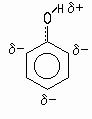
In phenol both effects occur. The oxgen draws s electrons from the ring. A lone pair of electrons is fed into the pi Cloud. Overall the pi effect is greater and the ring becomes asymetrical with three delta minus charges as shown in the diagram.
Summary
- Phenols are potentially very reactive towards electrophilic aromatic substitution
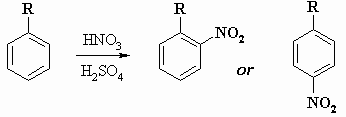
- This is because the hydroxy group, -OH, is a strongly activating, 2 / 4 directing substituent
- Substitution typically occurs 4 to the hydroxyl group unless the 4 position is blocked, then 2 substitution occurs.
- The strong activation often means that milder reaction conditions than those used for benzene itself can be used (see table below for a comparison)
- Phenols are so activated that polysubstitution can be a problem
| Reaction |
|
|
| Nitration | dil. HNO3 in H2O or CH3CO2H |
|
| Sulphonation |
|
|
| Halogenation |
|
|
| Alkylation |
|
|
| Acylation |
|
|
© LEV