


ICT in the Health Service
ICT in diagnosis
There are a large number of tools that have become available in the last ten to twenty years that have improved diagnosis in hospitals. Some are simple labour saving devices, there are machines that measure pulse blood pressure and breathing, a seriously ill patient is attached to this. It is not that long ago that a nurse would be required to make 5 10 or 15 minute readings of the patient. These machines are often manufactured as separate devices with dedicated chips that perform a limited number of functions. They are relatively cheep and very mobile
Perhaps of greater importance are computer based diagnostic tools these often come in the form of specialist software written to run on a PC which may have an additional input / output board to link it to a probe or similar. The most obvious example of this type of tool is the use of the Doppler effect coupled with ultrasound to detect blood flow. For those of you interested in the physics of this process know where to look. It is not of consequence to the ICT A level.
Doppler Echocardiography
Doppler echocardiography is a valuable tool in the assessment of cardiac disease. It can provide important information in addition to the standard 2-dimensional ultrasound study. Doppler ultrasound utilizes the phenomenon of the Doppler effect.
What is the Doppler Effect? The Doppler effect involves the ability of moving red blood cells to shift the frequency of reflected sound waves. The ultrasound probe is designed to emit sound waves at a particular frequency. These waves reflect off of moving RBCs and the returning sound waves are detected by the ultrasound machine. RBCs moving away from the ultrasound probe decrease the frequency of the reflected sound. RBCs moving toward the probe increase the frequency of the reflected sound. The magnitude of these shifts is proportional to the speed of the blood cells. By measuring these changes in frequency, Doppler ultrasound can determine the velocity and direction of blood flow within the heart.
Three forms of Doppler echocardiography. There are three forms of Doppler ultrasound that are used in evaluating blood flow, continuous wave (CW), pulsed wave (PW), and colour flow.
- Continuous wave Doppler is used to measure high velocity blood flow within the heart.
- Pulsed wave Doppler is "location sensitive". It is used to examine blood flow in a particular section of the heart and cannot accurately measure high velocity flows.
- Colour flow Doppler is an expanded form of PW Doppler and uses colour pixels to display blood velocity and direction information. These colour boxes are superimposed over the standard ultrasound image enabling you to "see" blood flow through the heart. In this case the computer monitor enables the doctor to "see" data and understand it in a displayed form similar to that shown below:
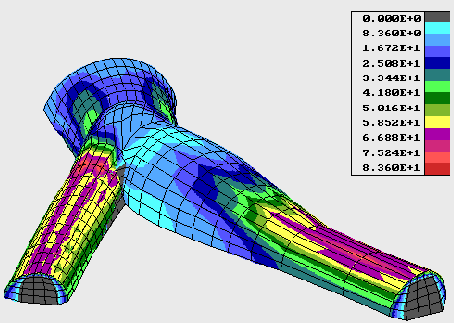
None of these techniques would be possible without the ICT component making light work of the complex mathematical calculations involved. Quite apart form the fact that this technology is relatively cheep (a few thousand pounds a time) it is non invasive. The process is quick and risk free. Prior to this the only option was surgery. Here the patient is most often an out patient. So the benefits are substantial.
©LEV