


Data Normalisation
The purpose of a relational database is to achieve the aims of a database approach by defining the relationships between flat file structures or tables. If data independence is to be achieved then the data stored in the tables must be normalised. Normalised data has the following attributes:
- Each record in a particular table will have the same number of fields. (This is called First Normal Form).
- In addition to being in first normal form (1NF), each non-key data item in the record is fully dependent on the primary key; i.e. the primary key alone could be thought of as determining the other data in the record. (This is called Second Normal Form). The term fully dependent here requires that each non-key item must depend on the whole of the primary key. In some cases -particularly when the primary key is concatenated - there may be non-key data items that are dependent on only part of the primary key. In this case the record structure is not in 2NF.
- In addition to being in second normal form (2NF), each non-key item in the record is fully independent of any other non-key data item in the record. (This is called Third Normal Form and is the usual limit of normalisation)
The initial two entities given if fig 1 were not in first normal form. The original attributes of member included the music that had been issued. Since not every member plays in each item, different members would be issued different numbers of parts. Similarly different musical works contain different numbers of parts. Neither of these entities conforms with first normal form since the number of occurrences of each attribute varies from one occurrence of the entity to the next.
The redefined entities are all in first normal form because every occurrence of a particular entity has the same structure as any other.
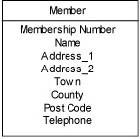
Fig 5 Member record Structure
Let's look at the member entity. This has the attributes shown of membership number, address and telephone. If mailing labels have to be produced then the address must be broken down into a number of fields, one for each line.
This is in first normal form because each occurrence of the entity member possesses all of the attributes given (although for some the second address and the telephone attribute may be an empty value).
Since the membership number identifies the member, once the number is known all the other attribute values are determined. We say that the other attribute values are functionally dependent on the membership number that is the key field. The record structure is therefore in second normal form.
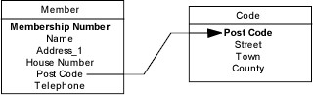
Fig 6 Two record structures in 3NF
However it is not in third normal form because most of the address is functionally dependent on the postcode. Given a postcode the street name, town and county can be determined. Assuming that Address_1 is used for the house name - if there is one, and Address_2 is the house number and street name then we can put Member records into 3NF by creating an additional entity called Code. Address_2 is split into house number - which is functionally dependent on Membership Number and so remains in the member record, and Street - which is functionally dependent on the postcode and moves to the new record along with town and county. Postcode in the member's record is now a foreign key - i.e. it is a pointer to another type of record in which it is the primary key.
You might think that county is functionally dependent on town but this is not the case since the same town name can occur in several different counties. Fixing the name of the town does not therefore tell you the name of the county.
You might like to consider whether telephone number could be split into two parts, one part of which is functionally dependent on the first part of the post code and which should not therefore be present in the member record if it is to be in strict 3NF.
It is important to remember that the purpose of normalisation is to produce record structures that are independent of the applications that may need to access them. The applications will access virtual records that will draw related data from a number of different tables using the foreign keys as pointers to put the data together
Database Administrator
This is a person who is responsible for the database. He or she will:
- Maintain the database, including the addition of new records.
- Maintain the data dictionary. This is data about the database
itself. It lists:
- The entities, their attributes and their relationships.
- The alias used for a particular attribute - e.g. name, full_name, customer_name
- How to access the data in various ways
- What data codes have been used and their meaning
- Origin of the data
- Ownership of the data
- Produce user manuals
- Liase with users to ensure that their data requirements are being met.
The Database Administrator will need to have a good understanding of the information needs of the organisations and its personnel.
© LEV
