


Digital scanners
A scanner is a device that analyzes a physical image (such as a photograph, printed text, or handwriting) or an object (such as an ornament) and converts it to a digital image.
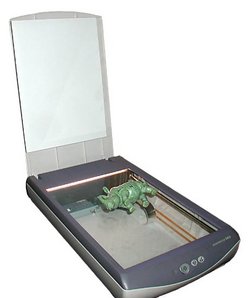
Most scanners today are variations on the desktop (or flatbed) scanner. A desktop scanner is usually composed of a glass pane, under which there is a bright light (often xenon or cold cathode fluorescent) which illuminates the pane, and a moving charge-coupled device. Colour scanners typically contain three rows of charge-coupled device elements with red, green, and blue filters. Images to be scanned are placed face down on the glass, the light turns on, and the charge-coupled device and light source move across the pane reading the entire area. An image is therefore visible to the charge-coupled device only because of the light it reflects. Transparent images do not work in this way, and require special accessories that illuminate them from the upper side.
Scanner quality
The colour depth and the resolution detirmine a scanners quality. Colour depth varies depending on the charge-coupled device characteristics, but is usually at least 24 bits. The resolution is measured in dots per inch (dpi), Instead of using the scanner's true optical resolution, the only meaningful parameter, manufacturers like to refer to the interpolated resolution, which is much higher thanks to softwareinterpolation. As of 2004 a good flatbed scanner has an optical resolution of 1600–3200 dpi, high-end flatbed scanners can scan up to 5400 dpi.
Output data
The final result is a non-compressed RGB image which is typically transferred to a host computer's memory. Such an image can be processed with a raster graphics program (such as PSP) and saved on a storage device.
Computer connection
The amount of data generated by a scanner can be very large: a 600 DPI 9"x11" (slightly larger A4 paper) uncompressed 24-bit image consumes about 100 mB of uncompressed data in transfer and storage on the host computer. Recent scanners can generate this volume of data in a matter of seconds. Therefore, a fast connection is optimal.
Early scanners had parallel connections that could not go faster than 70 kb/s. Recent models use USB 2.0 connections that can transfer up to 60 megabytes per second.
© LEV
