


2. Hints for Drawing Data Flow Diagrams
For a diagram to be useful it must be at an appropriate level of detail:
- avoid detail initially;
- identify external entities - they provide the boundary;
- identify main processes, then concentrate on data flows;
- ensure enough dataflows go into a process to perform transformations;
- ignore timing, except for logical procedures (this point will be returned to);
- duplicate external entities and data store to improve clarity of diagram;
- use meaningful names;
- do not duplicate data flows;
- be prepared to modify and re-draw;
- prepare in conjunction with users.
Duplicate external entities are usually represented by:
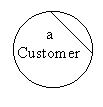
Figure 8: Duplicate External Entity Symbol
Duplicate data stores are usually represented by:
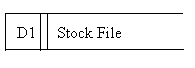
Figure 9: Duplicate Data Store Symbol
To meet these requirements the Data Flow Diagram - Level 1 would normally have between 4 and 8 processes, with the outside limit being 12. Also we might combine some unimportant Data flows, Data stores and Externals (if such a judgement could be properly made). Again let me emphasise, don't overdo splitting processes down this can be done at the next stage and the processing is summarised in a 'Process Description'. A process description is a detailed explanation of the inputs and outputs to and from the process, an explanation of which users interact with the process, details of what data stores are accessed and updated and error handling information.
© LEV
