


Combustion
Like any other hydrocarbons, benzene and methylbenzene burn in a plentiful supply of oxygen to give carbon dioxide and water. For example:
For benzene:

However, for these hydrocarbons, combustion is hardly ever complete, especially if they are burnt in air. The high proportion of carbon in the molecules means that you need a very high proportion of oxygen to hydrocarbon to get complete combustion. As a general rule, the hydrogen in a hydrocarbon tends to get what oxygen is available first, leaving the carbon to form carbon itself, or carbon monoxide, if there isn't enough oxygen to go round.
The arenes tend to burn in air with extremely smoky flames - full of carbon particles. You almost invariably get incomplete combustion, and the arenes can be recognised by the smokiness of their flames.
Hydrogenation
Hydrogenation is an addition reaction in which hydrogen atoms are added all the way around the benzene ring. A cycloalkane is formed. For example:
With benzene:
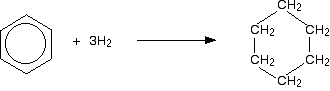
These reactions destroy the electron delocalisation in the original benzene ring, because those electrons are being used to form bonds with the new hydrogen atoms. Although the reactions are exothermic overall because of the strengths of all the new carbon-hydrogen bonds being made, there is a high activation barrier to the reaction. The reactions are done using the same finely divided nickel catalyst that is used in hydrogenating alkenes and at similar temperatures (around 150°C), but the pressures used tend to be higher.
Chlorine (addition)
In the presence of ultraviolet light (but without a catalyst present), hot benzene will also undergo an addition reaction with chlorine or bromine. The ring delocalisation is permanently broken and a chlorine or bromine atom adds on to each carbon atom. For example, if you bubble chlorine gas through hot benzene exposed to UV light for an hour, you get 1,2,3,4,5,6-hexachlorocyclohexane.
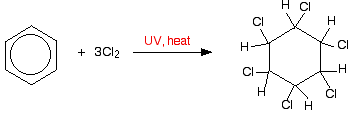
Bromine would behave similarly.
The chlorines and hydrogens can stick up and down at random above and below the ring and this leads to a number of geometric isomers. Although there aren't any carbon-carbon double bonds, the bonds are still "locked" and unable to rotate. One of these isomers was once commonly used as an insecticide known variously as BHC, HCH and Gammexane. This is one of the "chlorinated hydrocarbons" which caused so much environmental harm.