


Input Devices
A variety of input devices have already been described in the section on data capture. Most of these have been designed with particular types of application in mind. In these situations there must be a match between the performance of the input device and the demands of the application.
Keyboard
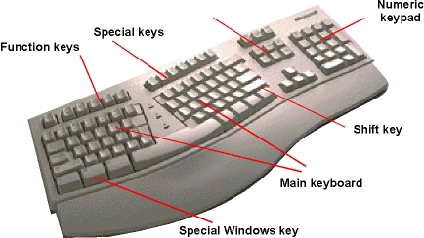
The QWERTY keyboard remains the most common input device although in terms of speed of input it is one of the most limited. It is however suitable for entering a wide range of data and it is a device that is familiar every clerical worker. The QWERTY layout was designed to reduce the chance of jamming on early mechanical typewriters. This was achieved by spreading the most commonly used letters around the keyboard, effectively slowing the typist down.
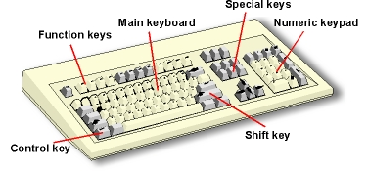
Improved layouts have been designed and they do increase the speed at which data can be entered. However they have never become popular, partly because there has been no general agreement on a new standard layout but mainly because of the time that people have invested in learning to use the existing arrangement.
Mouse
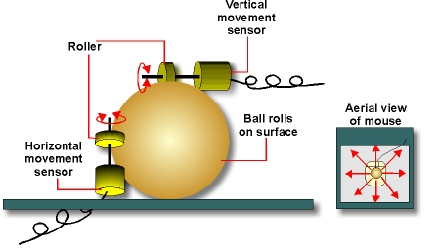
A mouse is almost exclusively used in conjunction with a keyboard as part of a WIMP Graphic User Interface. The mouse is moved and the speed and direction of movement are echoed in the movement of a pointer on the VDU screen. This is achieved by using a rubber coated ball which cause two movement sensors to be activated. More modern mice use reflected light to detect movement. This overcomes the problems of dirt and fluff blocking up the mechansim.
Buttons on the mouse can be used to pull menus that the pointer is on down or to select menu options.
A mouse can be used to input data for drawing or graphic design programs. Again a pointer or similar icon is moved around the screen as the mouse is moved by the user.
The mouse is useful for inputting both relative movement and speed of movement. It does not however provide data about absolute positions. In other words the computer can detect how far left or right the mouse has been moved but it will not know whereabouts the mouse is on the desk.
One problem with using a mouse is that it needs a flat surface to move over. This has led to the use of a small roller ball on laptop computers where there may be no suitable surface available for a mouse.
Mice are very susceptible to dust and dirt which makes them produce erratic data, causing the pointer on the screen to jump rather than move smoothly. This can be prevented by regular cleaning and the use of a mouse mat.
There is increasing interest in the use of cordless mice and keyboards which link to the computer with infra-red radiation thus allowing the user to position the hardware with greater freedom.
Graphics Tablet and Light Pen
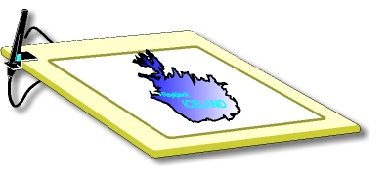
A graphics tablet is a specialist input device for technical drawings. It consists of a flat tablet and a stylus. The absolute position of the stylus on the tablet's surface can be detected. This provides an input device that is similar to the paper and pencil that the user may already be familiar with.
A similar effect is achieved with a light pen except in this case the flat surface is the VDU screen itself. The pen is triggered by the raster scan of the VDU - it detects when the electron beam building up the screen image has just passed the point where the pen is positioned. Knowing the instant at which the beam passed the pen, the software can calculate whereabouts on the screen it has been placed.
Touch Screen Monitor
The monitor detects the position of a finger placed on the screen. One method of doing this is to have a series of horizontal and vertical infrared beams directed across the screen. Position is calculated from detecting which beams have been interrupted.
This method of input has limited accuracy because the input device is fairly large. It can be used to choose menu items from a selection displayed. Its principal use is in data display applications where the user can select one of a limited number of choices by pointing at the screen. It has the advantage of limiting what the user can do to the system.
Concept Keyboard
This is a keyboard-like device with a number of pictures instead of the usual keys. The user indicates input by pressing one of the pictures. It is used as an input device for young children in Computer Based Learning systems and it is sometimes used in cafés and pubs where there is a computerised till. A feature of this device is the capability to change the overlay to provide a different set of pictures. This is particularly useful in computer based learning as a single keyboard can then be used with a variety of overlays.
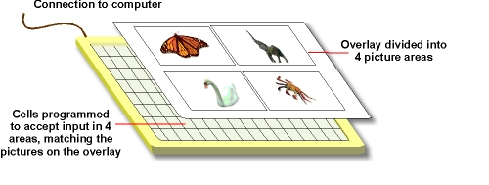
© LEV
