


Backing Storage
The purpose of backing storage is to store that data that is not currently being processed. Backing storage is needed primarily because the central memory is finite but also because it is volatile. Backing storage is usually based either on magnetic or optical methods of storing data but recently a combined magneto-optical technology has been developed. Magnetic methods have the advantage that the medium can be reused - i.e. the existing data can be written over.
Both magnetic tape and magnetic disc require formatting before use. This is essentially a process of marking out the medium into usable areas in a way that allows the tape unit or disc drive to find its way about the medium when reading and writing at a later time.
Magnetic Tape
The tape used in large computer systems is 0.5 inches wide and is mounted on a reel. The reel is placed in a special tape unit for use and the tape is automatically fed onto another reel. A tape of this type can store tens of gigabytes of data but it is likely to hold one file only. A file that is stored on tape must be sequential access and only the sequence that records are physically stored in is possible. This is because the tape is read from start to end and it would not be realistic to wind back and forth along the tape to find records in an out-of-sequence order.
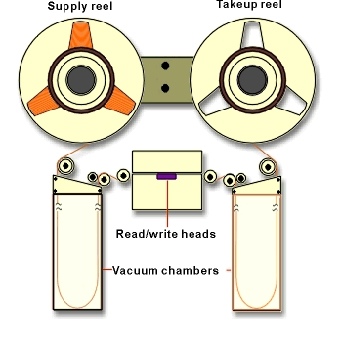
Tape cartridges are a smaller form of magnetic tape. They are sealed units usually holding 0.25 inch tape and, like an audio cassette, both reels are built into the cartridge. Cartridges are used almost exclusively to hold backup-up copies of hard discs on small computer systems (a tape streamer). A cartridge can store up to about 20 gigabytes of data.
Magnetic Discs
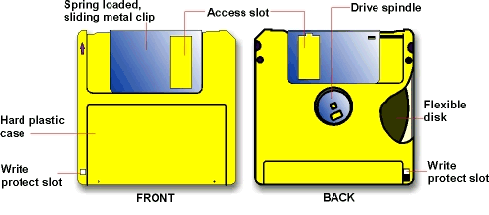
There are three types of magnetic disc. The magnetic disc pack, used in mainframe and mini computer systems is capable of holding several gigabytes of data. The Winchester hard disk is contained in a small sealed unit and is used on PC systems. This type of disc can store up to about 9 gigabyte of data and has a longer access time than the disc pack used on larger systems. Finally the floppy disk which has the longest access time of all because it spins slowly can hold up to about 2 megabytes of data and it is used to transfer data between computers where no network link exists, to supply software and in some cases to back up personal computer systems. Floppy discs normally have a write-protect mechanism. By positioning a small tab the disc is tagged as read only, thus protecting against accidental erasure.
Hard discs (both disc pack and Winchester) in fact consist of a number of disks mounted on a common spindle.
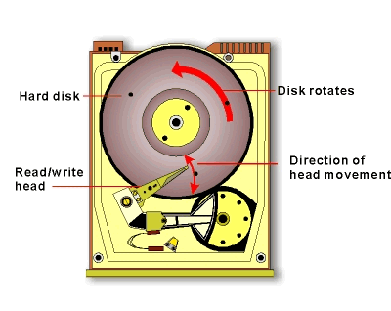
Data is stored in concentric rings called tracks. Normally a particular item is found on a disc by moving the read/write head in to the appropriate track and then waiting for the data required to come round and be read. In some large systems, where access time is critical, fixed heads are used.
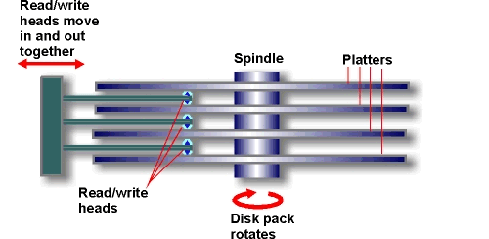
There is one head per track so that the need to move the head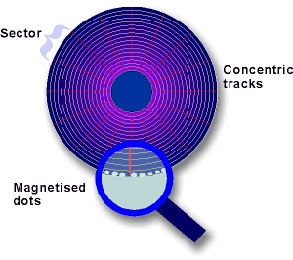 d to the correct track is eliminated. This
improves access time but the cost is increased.
d to the correct track is eliminated. This
improves access time but the cost is increased.
Data can be stored on any magnetic disc to allow either sequential or random access. If random access is used then the records must be fixed length (every record taking up the same amount of storage space) so that the position of a particular record on the disc can be calculated. Fixed length records are normally achieved by having fixed field lengths, padding out fields that are not long enough with space characters.
Optical Disc
This is often called CD-ROM. The disc is the same size as an audio CD and it is read in the same way. Data cannot be changed (hence the ROM). Access is slower than a hard disc (pack or Winchester) because the spin speed is slower. A CD-ROM can store about 650 megabytes of data. They are used in situations where the data does not age quickly. Examples include encyclopedias, large catalogues and telephone directories. Software is increasingly supplied on CD-ROM. This is because a modern program may require more than 10 floppies to provide the data for installation. In this situation a CD-ROM becomes cost effective.
WORM optical disks (Write Once Read Many) allow the user to write onto the surface of a CD-ROM. This can only be done once since the surface is permanently changed during the writing process. The resulting disc can be read by a normal CD ROM drive. This is useful for archiving data or for small-scale CD ROM production.
Magneto-Optical Storage
These discs have a magnetic surface that can only be magnetised when heated to about 200oC. A laser beam is used to heat a spot on the surface that is then magnetised to record the data. The direction of magnetisation affects the light reflecting off the surface, so the data can be read optically. These devices are comparatively new and at present provide about 125 megabytes of storage on a disc the same size as a floppy. The can be used for backup and archiving data and for transferring data from one system to another. In addition to their vastly increased storage space compared to a floppy disk, they have the advantage that the data stored is less vulnerable to stray magnetic fields and temperature effects since the surface of the disc must be heated before the data can be changed.
© LEV
