


2 Components of a Data Flow Diagram, (SSADM notation)
We are now going to look inside the box and diagrammatically represent the processing of the inputs to the system to get the outputs from the system. We are going to use the following notation (this is SSADM notation - the most popular system development, it's used by the MOD and other Government departments and therefore worth learning):
a) Information Flow :
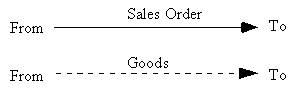
Figure 3: Data Flow Symbol
A data flow can be thought of as a pipeline through which packets of data of known composition flow. Data flows must be an input or output of a Process Box. Physical flows are sometimes represented by a double or dotted line.
b) Process :
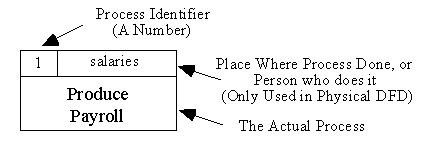
Figure 4: Process Symbol
Transforms incoming flows into outgoing flows. Each Elementary Process can / should be documented with a brief Process Description, a brief outline of the processing activity which is taking place.
c) Source/Destination (or Sink) of Data, (External) :
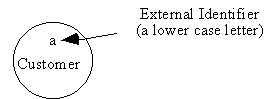
Figure 5: External Entity Symbol
External entities are sources or sinks of data (people or organisations) that are lying outside the context of the system. Source/Destination must be external to system, and must be a source or destination of input or output to/from the system. Externals don't speak to each other. There are other notations apart from the circle but we will be using the circle.
d) Internal Data Store, (File) :
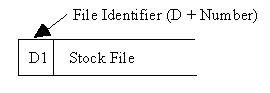
Figure 6: Data Store Symbol
Data stores can hold permanent, temporary, historical or extract data. Files receive inputs and outputs only from Processes, NOT from Externals or other Files. Identifier may be D or M (Data (computer implementation) or Manual e.g. In-Tray).
© LEV
