


Tablet PC
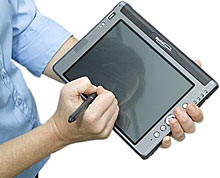
This is a notebook- or slate-shaped mobile computer. Its touch screen or digitizing tablet technology allows the user to operate the computer with a stylus or digital pen instead of a keyboard or mouse. Tablet PCs are often used where normal notebooks are impractical or unwieldy, or do not provide the needed functionality. In ICT Teaching and for giveing lectures many teachers use a tablet to control thier Ineractive White Board. They can then move freely about the room as they teach or lecture as the device can easily be held in one hand.
A user can enter text using handwriting recognition, an on-screen (virtual) keyboard, speech recognition, or standard keyboard. Shorthand-like entry methods, which enable pen-driven input at speeds comparable to touch-typing, and are unique to the Tablet PC, include AlphaTap and Shark
.
Modern day processors and advances in recognition algorithms make the conversion from handwriting to text far more practical now than it was in early attempts of tablet PCs.
Current handwriting recognition technology employed by tablet PCs focuses more on generic times recognition, rather than letter recognition. Each block of handwriting is compared to a dictionary of words. The word with the closest spelling to its primary guess of the written word is chosen, often with a list of alternatives presented to the user. On words in the dictionary, this method is more accurate than letter recognition. However, this becomes a problem for words not in the computer's dictionary, such as email and web addresses, new slang terms, and proper names. Handwriting recognition software often presents a letter recognizer option to better enable precise input.
© LEV
