


Light Pens
A light pen is a computer input device in the form of a light-sensitive wand used in conjunction with the computer's CRT Monitor. It allows the user to point to displayed objects, or draw on the screen, in a similar way to a touch screen but with greater positional accuracy. A light pen can work with any CRT-based monitor, but not with LCD screens, projectors or other display devices.
A light pen is fairly simple to implement. The light pen works by sensing the sudden small change in brightness of a point on the screen when the electric gun refreshes that spot. By noting exactly where the scanning has reached at that moment resolves the X,Y position of the pen. This is usually achieved by making the light pen cause an interupt, at which point the scan position can be read off from a special register, or computed from a counter or timer. The pen position is updated on every refresh of the screen.
The light pen became moderately popular during the early 1980s. It was notable for its use in the Fairlight CMI, and the BBC Micro. However, due to the fact that the user was required to hold his or her arm in front of the screen for long periods of time, the light pen fell out of use as a general purpose input device.
Barcode reader 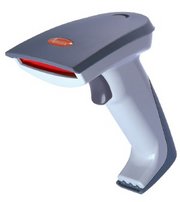
This is a computer periforal for readingbarcodes printed on various surfaces. Like a flatbed scanner, it generally consists of a light source, a lens and a photo conductor translating optical impulses into electrical ones. Additionally, nearly all barcode readers currently produced contain decoder circuitry analyzing the barcode's image data provided by the photo conductor and sending the barcode's content to the scanner's output port.
Laser range scanner
This acquires three dimensional geometry by scanniongalaser across an object. The device measures the time of flight of the laser pulse to determine the distance from the scanner to each point on the object that the laser reflects off of.
"Object" can be a discrete object, a small environment such as a room, a larger environment such as a group of historic structures, or an entire landscape surveyed from the air.
A laser range scanner produces a three dimensional points representing the object scanned.
© LEV
